
7 Best AI Autoblogging Tools That Publish to WordPress for Agencies and Niche Site Owners
You are probably paying writers per post while your publishing calendar sits half empty. Some tools promise WordPress automation but still leave you copying drafts by hand, and many platforms quietly cap output right when an agency client needs 40 posts. That gap between promise and workflow is what pushes most people to switch.
This article breaks down what actually matters: real WordPress publishing, content quality, and features that hold up at agency scale. You will get a clear comparison of seven tools, a look at Autoblogging.ai's modes and pricing, and practical guidance on matching a tool to your niche site or client workload.
What to Look For in AI Autoblogging Tools That Publish to WordPress
When evaluating AI autoblogging tools that publish directly to WordPress, the difference between a smooth workflow and a technical headache often comes down to three core factors: publishing reliability, content quality, and scalability.
Publishing reliability determines whether a scheduled post actually appears on your site without you logging in to fix it. Content quality decides whether Google and readers treat that post as useful or as noise. Scalability determines whether the tool still works when you manage five sites instead of one.
For agencies and niche site owners, these factors interact. A tool with excellent writing but fragile publishing creates constant cleanup work. A tool with perfect integration but thin, repetitive output builds a site that never ranks.
This section breaks down what to examine under each factor, so you can compare the seven tools that follow on equal terms. The goal is not to find the longest feature list, but to find the combination that matches how you actually run your sites.
WordPress Publishing, Content Quality, and Agency-Scale Features
The most reliable AI autoblogging tools connect to WordPress through native APIs like REST or XML-RPC, or via dedicated plugins, ensuring that scheduled posts go live without manual intervention.
Each connection method has tradeoffs. The WordPress REST API is the modern standard and handles authentication through application passwords, which most managed hosts support. XML-RPC is older but still widely enabled, and some tools fall back to it when REST fails. A dedicated plugin can simplify setup, though it adds another component to keep updated.
Whichever method a tool uses, test the failure path. Ask what happens when a post is rejected, whether drafts are preserved, and whether you receive any notification. Silent failures are the most expensive kind for anyone running scheduled publishing at volume.
Practical checks for the publishing layer:
- Support for custom post types, not just standard posts
- Taxonomy mapping, so categories and tags are assigned automatically
- Featured image handling, including alt text
- Author assignment, useful when multiple writers or brands share a site
- Scheduling controls such as drip feed intervals and time zone handling
On content quality, look beyond fluent sentences. Originality matters, because content spinning and recycled text can trigger thin-content problems. Readability matters for engagement. SEO fundamentals matter for discovery, including natural keyword usage, meta title and description generation, internal linking, and heading structure.
Tools built on modern large language models, including those using the OpenAI API or GPT-4 class models, tend to produce more coherent long-form output than older article generators. Prompt engineering and content templates also shape results, since a well-structured brief usually beats a single vague keyword.
For agency-scale operations, the feature set shifts. Bulk content generation matters more than one-off posts. Multi-site management from a single dashboard saves hours each week. User roles and permissions help when team members or clients need limited access. Drip feed scheduling keeps publishing steady rather than dumping fifty posts in one day, which looks unnatural to search engines.
Also consider workflow features that support repeatable processes: an editorial calendar view, approval steps before publishing, and the ability to organize campaigns by client or niche. Niche site owners running programmatic SEO or affiliate marketing projects often need keyword research and topic clustering support built in, or at least clean export to the keyword tools they already use.
Finally, weigh how much of the process runs in autopilot mode. Hands-free blogging sounds appealing, but the best setups still leave room for review. A tool that supports both full automation and manual checkpoints gives you room to scale quality control as your portfolio grows.
1. Autoblogging.ai - Best Overall
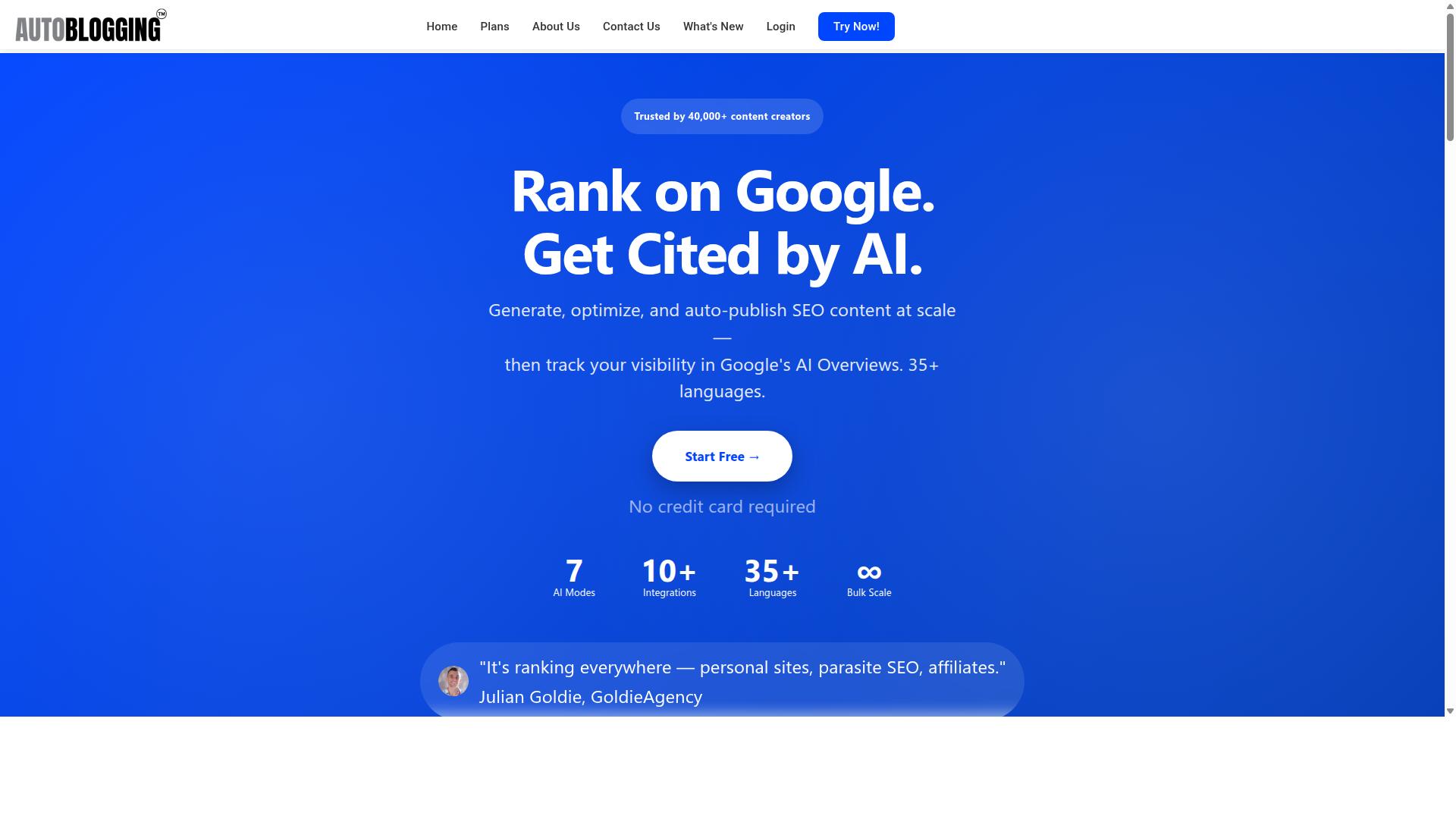
Autoblogging.ai stands out as the best overall AI autoblogging tool for WordPress due to its robust feature set, seamless publishing, and scalability for agencies and niche site owners. It combines article generation, SEO optimization, and direct publishing in a single platform, which removes the usual patchwork of tools that content teams juggle.
The platform is trusted by 40,000+ creators and holds a 4.9 rating. That kind of adoption matters for agencies managing multiple client sites and for niche site owners running lean operations, because it signals the tool has been stress-tested across a wide range of publishing workflows.
Where many AI writers stop at producing text, Autoblogging.ai carries content through optimization and straight into a live WordPress site. New accounts also get 10 free credits per month with no credit card required, so teams can evaluate the output quality before committing to a paid tier.
For agencies, the appeal is scale without added headcount. For solo niche site owners, it is the ability to run something close to hands-free blogging while still applying SEO content standards. The sections below break down exactly how the modes, pricing, and WordPress publishing work.
Modes, Pricing, and One-Click WordPress Publishing
Autoblogging.ai offers multiple content generation modes, including Quick Mode for free single articles and Godlike Mode for in-depth SERP analysis and LSI keyword integration, all publishable to WordPress with one click. Each mode serves a different stage of a content operation.
- Quick Mode handles free single articles and includes a wizard for guided generation.
- Godlike Mode runs SERP competitor analysis, integrates LSI keywords, and performs knowledge graph extraction for deeper topical coverage.
- Bulk Generation produces up to 500 articles via CSV, which suits bulk content generation for large niche portfolios or client rosters.
- News Mode connects to Google News, and Amazon Reviews Mode supports affiliate marketing content.
Optimization tools round out the workflow: Site Optimizer, Semantic SEO Analysis with a 21-point audit, Snippet Optimizer, Topical Maps, Intense Optimizer, Fan Out Queries, AI Infographics, Outreach Prospects, AI Proofreader, and Human Proofreader. Together these cover keyword research, topic clustering, and semantic SEO without leaving the platform.
Publishing is where the tool separates itself. WordPress integration supports unlimited sites with one-click publishing, a plugin option, and scheduled auto-posting, which effectively creates a drip feed or autopilot mode for automated blog posts. A WordPress REST API connection and broader API access extend the same workflow to custom setups, alongside Zapier and n8n for automation chains.
Beyond WordPress, content can be distributed to Web 2.0 platforms including Medium, Dev.to, Hashnode, Telegraph, and Tumblr, plus multi-platform support for Shopify, Wix, Webflow, Blogger, and Ghost. A Content Repurposer helps extend the life of existing articles.
Pricing scales with output. Monthly plans run from Starter at $19 for 40 credits through Regular $49 (120 credits), Standard $99 (300 credits), Gold $179 (600 credits), Premium $249 (1,000 credits), and up to Enterprise at $999 for 5,000 credits. All plans include credits rollover, so unused capacity is not lost between billing cycles.
Annual billing lowers the effective rate: Starter $12/mo ($148/year), Regular $32/mo ($382/year), Standard $64/mo ($772/year), Gold $116/mo ($1,396/year), Premium $162/mo ($1,942/year), and Enterprise $649/mo ($7,792/year). Additional credits can be purchased as needed, and payment options include Visa, MasterCard, American Express, PayPal, and bank transfers for annual enterprise plans via Stripe. Subscriptions can be canceled anytime.
For teams that prefer a fully managed route, Done For You packages are available: Starter $1,200 for 1,000 articles, Pro $1,600 for 1,000 articles, Corp $4,000 for 1,000 articles, and Senpai $10,000 for 1,000 articles. That gives agencies a way to scale output without building an in-house production pipeline first.
2. SEOWriting.ai
SEOWriting.ai is a popular AI writing tool that offers WordPress publishing, but it may lack some advanced automation features found in top-tier autoblogging solutions. It has built a following among bloggers and marketers who want to produce SEO content quickly without wrestling with complicated settings.
The tool leans heavily into bulk content generation, making it a reasonable fit for agencies juggling multiple client blogs or niche site owners managing several properties at once. Its standout feature is 1-click generation and auto-posting, which shortens the gap between writing an article and seeing it live on a site.
For teams that already have a WordPress workflow in place, that combination can reduce a lot of manual copy-and-paste work. Still, it sits closer to the AI writer category than to a full autoblogging platform.
Strengths in SEO Content Creation
SEOWriting.ai positions itself around search-friendly output. The tool is built to generate articles that target keywords, which matters for anyone running an affiliate marketing site or a content-driven niche website.
Typical strengths reported by users include:
- Article generation shaped around target keywords and search intent
- Support for longer-form content suited to blog posts and landing pages
- Templates and prompts that reduce the blank-page problem for new users
- Output that can be reviewed and edited before publishing
These features align with the broader shift toward semantic SEO and topic-focused content, where a single article needs to cover a subject thoroughly rather than repeat a keyword. The tool fits that model reasonably well for straightforward blog content.
What it does not appear to offer is deeper programmatic SEO infrastructure, such as automated topic clustering or large-scale internal linking logic. Those capabilities tend to matter more to agencies running dozens of sites than to a single blogger publishing a few posts a week.
WordPress Integration and Publishing
WordPress publishing is one of the tool's core selling points. The auto-posting feature connects the writing process directly to a WordPress site, so a generated article can move from draft to published without leaving the platform.
This is the kind of plugin integration that saves time on repetitive tasks. For a solo niche site owner, it can mean the difference between publishing consistently and letting a blog go stale. For an agency, it can trim hours of administrative work across a client roster.
That said, the automation depth is where the tool shows its limits. More advanced autoblogging setups often include scheduled publishing, drip feed options, and autopilot mode that keeps a site updated with minimal intervention. SEOWriting.ai's publishing flow is more hands-on by comparison, which means users still need to plan and trigger content regularly.
It is worth checking how the integration behaves on your specific WordPress setup, since plugin conflicts and hosting restrictions can affect any auto-posting tool. Testing on a staging site first is a sensible step before rolling it out across multiple properties.
Pricing and Plan Limits
SEOWriting.ai offers a free plan that includes 3 free articles up to 25,000 words, which gives new users a way to test the output quality before committing. That is a reasonable entry point for anyone curious about the tool's writing style.
Beyond the free tier, pricing scales with usage, and heavier bulk generation typically requires a paid plan. Agencies producing content at volume should map their expected monthly output against plan limits before choosing a tier.
Key limitations to keep in mind:
- Free plan output is capped, so it works for testing rather than ongoing publishing
- Bulk generation limits apply on lower tiers
- Advanced automation features common in dedicated autoblogging platforms are not a core focus
For niche site owners publishing a handful of posts weekly, the tool can be a practical fit. For agencies needing hands-free blogging across many sites, the manual steps involved may add up over time.
Best Use Cases
SEOWriting.ai tends to work best for users who want an AI writer with a direct line to WordPress, rather than a fully automated content engine. It suits bloggers who still want editorial control over what goes live.
Common use cases include:
- Affiliate marketers building out review and comparison posts
- Niche site owners who want to publish more consistently
- Agencies producing first drafts for client blogs at scale
- Content teams that need SEO-focused articles without a steep learning curve
Where it may fall short is in large-scale content automation, such as managing an editorial calendar across dozens of domains or running programmatic SEO campaigns. Those workflows usually call for tools built specifically around autopilot publishing.
Overall, SEOWriting.ai is a credible option in the AI autoblogging tools space, particularly for users who value simplicity and one-click publishing over deep automation. It earns its place in a roundup, but buyers should weigh how much manual oversight they are willing to accept.
3. Koala AI

Koala AI focuses on generating high-quality, long-form content and offers WordPress publishing through integrations, making it suitable for bloggers who prioritize depth over volume. The platform is built around two main components: Koala Writer, an SEO-focused AI writer, and Koala Chat, a chatbot for lighter conversational tasks.
Koala Writer is the stronger of the two. It produces publish-ready, SEO-optimized articles in one click, which appeals to niche site owners who want to move from keyword to draft quickly. The tool supports Amazon affiliate articles, a useful feature for anyone building review-style content around products.
Beyond one-click generation, Koala AI offers tone-of-voice options, custom outlines, and Google Sheets integration. That combination gives writers more control than a purely push-button article generator, while still keeping the workflow fast.
- Content quality: Long-form, SEO-oriented articles with support for affiliate formats
- WordPress publishing: Handled through integrations rather than a native connector
- Pricing model: Entry pricing starts low, with the company advertising "prices starting at $9" and "GET 5000 WORDS FREE"
- Target audience: SEOs, affiliate marketers, and niche site publishers
The main trade-off is interface polish. The dashboard is basic, and Koala Chat feels limited next to the writer, so users expecting a full content suite may find the chatbot underwhelming.
For agencies running bulk content generation across many client sites, Koala AI works best as a drafting engine paired with a separate publishing workflow. Niche site owners focused on long-tail keywords and semantic SEO will likely get the most value from it.
4. Emplibot

Emplibot is an AI autoblogging tool designed for hands-free content publishing to WordPress, with a focus on automation and scalability. It positions itself as an AI SEO writer and blog post software that handles much of the content marketing workflow, from planning through publishing.
Rather than acting as a simple article generator, Emplibot builds a complete content plan by analyzing a business and its audience. From there, it researches keywords and creates an optimized content calendar, which gives users a structured editorial roadmap instead of a blank page.
The tool generates SEO-optimized content and can auto-publish to websites and social media accounts at what it describes as optimal times. This scheduled publishing and drip feed style of delivery is useful for niche site owners who want a steady stream of automated blog posts without logging in daily.
Emplibot's feature set leans toward the practical side of content automation:
- A smart content calendar for organizing upcoming posts
- Keyword research to guide topic selection
- An AI article writer with fact-checking built in
- Internal and external linking support
- Images and infographics generation
- Dynamic content banners
- Full SEO optimization
- Repurposing of blog content into social media posts
For agencies and niche site owners, the combination of keyword research and content scheduling is where Emplibot tends to be most relevant. It reduces the manual steps between picking a topic and getting a finished post live on a WordPress site.
Emplibot offers a free 7-day trial, which lets prospective users evaluate the workflow before committing. The platform is generally positioned for founders and small marketing teams, so it may suit lean operations more than large enterprise content departments.
As with any AI autoblogging tool, results depend on how well the content plan matches the site's niche. Emplibot appears to be a reasonable fit for users who want an integrated planning and publishing tool, though those needing deep customization may want to compare it against other options in this list.
5. ZimmWriter
ZimmWriter is a desktop-based AI writing tool that can publish to WordPress via integrations, appealing to users who prefer local software over cloud-based solutions. Instead of logging into a browser dashboard, users install the application on their own machine and run their content projects from there.
That local-first design is ZimmWriter's main selling point. A desktop application means drafts and project files live on the user's computer rather than on a vendor's servers. For writers who handle sensitive client material or simply want to avoid subscription-based cloud platforms, that distinction matters.
Publishing to WordPress is handled through plugin integration or API connections, so finished articles can move from the desktop app into a live site without manual copy and paste. The exact setup depends on the WordPress configuration, but the general workflow is the same: generate, review, then push to the site.
On the content side, ZimmWriter functions as a general-purpose AI writer driven by large language models. Users typically work through content templates and prompt engineering to produce blog posts, product descriptions, and other article formats. It is not positioned as a full autoblogging platform, so keyword research, topic clustering, and SERP analysis usually happen in separate tools.
Pricing is not published in the sources reviewed for this roundup, so check the vendor's site directly for current plans. As a general category, desktop AI writers tend to use one-time or license-based pricing rather than the monthly SaaS model common to cloud autoblogging tools.
Pros and cons for agencies and niche site owners:
- Runs locally, which suits users who prefer desktop software and offline access
- Publishes to WordPress through plugin or API connections
- Flexible templates support many content types beyond blog posts
- Scalability can be a limitation, since bulk content generation and hands-free scheduling are not its core focus
- No built-in SEO suite, so topic research and semantic SEO work happen elsewhere
- Managing multiple client sites is more manual than with a centralized cloud platform
For a solo niche site owner who writes in batches and wants local control, ZimmWriter can fit well. For an agency running programmatic SEO across dozens of sites, the lack of centralized scheduling and drip feed features may mean more hands-on work per project.
6. Arvow
Arvow is a lesser-known AI autoblogging tool that offers WordPress publishing and content automation, but it may lack the extensive feature set of more established options. Formerly known as Journalist AI, it has repositioned itself as an autonomous SEO content automation platform aimed at agencies, publishers, and high-volume SEO operators.
Its standout feature is the AutoBlog system, which generates and publishes articles without human approval. That hands-off approach appeals to operators running multiple niche websites who want an autopilot mode rather than a manual review queue.
Beyond WordPress, Arvow can push content to Ghost, Webflow, Shopify, Blogger, Wix, and Squarespace. That multi-platform reach is broader than many tools in this category, though the depth of each integration is not well documented in public sources.
Key Features
Arvow bundles a fairly wide set of capabilities into one dashboard. The core building blocks include:
- Auto keyword research to surface topic ideas without manual input
- An AI SEO Editor for refining drafts before or after publishing
- Custom content templates for repeatable formats
- Knowledge bases to feed the system background material
- A Site Optimizer for on-page improvements
On top-tier plans, Arvow states it can handle 1,000,000+ words per month, which puts it in the high-volume tier of AI autoblogging tools. Agency plan users also get API access, which opens the door to white-label resale.
That API access is worth noting for agencies that want to package content as their own service. It is a differentiator that some lower-cost tools simply do not offer.
WordPress Integration and Publishing
WordPress publishing appears to be a first-class feature rather than an afterthought. The AutoBlog system is designed to generate and auto-publish posts directly, which fits the hands-free blogging model many niche site owners prefer.
Because publishing can happen without approval, the workflow leans toward scheduled publishing and drip feed style output. For programmatic SEO projects, that kind of continuous output can be useful for building topical coverage over time.
That said, public documentation on the exact connection method is thin. It is unclear whether the integration relies on the WordPress REST API, XML-RPC, or a dedicated plugin. Readers evaluating it should confirm those technical details directly before committing.
Anyone running a content-heavy WordPress site should also test how the tool handles categories, tags, and featured images. These small details often determine whether automated blog posts slot cleanly into an existing site structure.
Content Quality and Limitations
Independent reviews paint a mixed picture of output quality. Bulk content has been rated roughly 4 to 6 out of 10, with an estimated 40 to 60 percent of articles needing editing before publication.
Brand voice accuracy has been reported at around 60 to 70 percent. For agencies working with client accounts, that gap matters, since inconsistent tone is one of the first things clients notice.
These figures come from third-party reviews rather than controlled testing, so treat them as directional. Results likely vary by niche, prompt setup, and how much source material you feed into the knowledge base.
For niche site owners focused purely on volume, the editing overhead may be acceptable. For agencies delivering client-ready work, a review step is probably still necessary despite the no-approval publishing option.
Pricing and Target Users
Arvow does not publish clear public pricing in the sources reviewed here, so anyone comparing plans should check the official site for current tiers. What is clearer is the intended audience.
The platform targets agencies, publishers, and high-volume SEO operators rather than casual bloggers. Features like API access, white-label resale, and million-word ceilings point to teams managing many sites or client accounts at once.
Niche site owners running affiliate marketing sites or small portfolios may find the entry point harder to justify if they only need a few posts per week. The value proposition scales with output volume.
If you are comparing AI autoblogging tools for WordPress publishing, Arvow is worth a look when raw throughput and multi-platform reach matter more than polish. If brand voice and minimal editing are priorities, the reported quality numbers suggest budgeting time for a human review pass.
7. Outrank
Outrank is an AI-powered content automation tool that publishes to WordPress, with a focus on SEO and scalability for niche sites and agencies. It bundles keyword research, article generation, and scheduled publishing into a single subscription, so users do not need to stitch together separate tools for each step of the workflow.
The platform is built around an all-in-one content pipeline. Instead of running keyword discovery in one app and drafting in another, users move from topic selection to published post without leaving the dashboard. That appeals to niche site owners who want fewer moving parts and to agencies managing repeatable output.
Publishing happens automatically to a connected site on a schedule. Articles can include AI-generated images, and the system is designed to keep a steady flow of automated blog posts going rather than requiring manual uploads each time.
Outrank's pricing is published openly, which makes it easier to evaluate before committing. The All-in-One plan is listed at $99 per month or $999 per year. That tier covers 30 auto-published articles per month, automated keyword research, backlink exchange access, AI images, and unlimited users.
Teams that need more output can add volume as an add-on rather than jumping to a higher tier:
- 60 articles per month adds $85
- 90 articles per month adds $160
Two other details stand out. Human editing is offered as a separate service at $1,399 per month, and multi-site accounts receive automatic discounts of 10 to 20 percent. Those discounts matter for agencies running several client properties at once.
The Backlink Exchange is one of Outrank's more distinctive features. Users earn credits by hosting relevant backlinks on their sites, then spend those credits to receive links in return. Verification is handled automatically, which removes some of the manual outreach that normally comes with link building.
For programmatic SEO projects and content-heavy niche sites, that combination of scheduled publishing plus link credits can support steady growth without a large team. Agencies may also find the unlimited users on the base plan useful for collaboration across writers and editors.
Outrank fits best with niche site owners and agencies that want keyword research, generation, and publishing handled in one place, and that value the backlink exchange as part of the package. The add-on structure keeps entry costs predictable while allowing output to scale.
There are tradeoffs to weigh. Human editing sits at a much higher price point than the base plan, so teams wanting polished, editor-reviewed content will pay significantly more. Volume beyond the included 30 articles also requires add-ons, which raises the effective monthly cost as output grows. As with any content automation tool, results depend on how well the generated drafts are reviewed and how competitive the target keywords are.
How to Choose the Right Option
Choosing the right AI autoblogging tool depends on whether you're running a solo niche site or managing multiple client websites as an agency. The same feature set that delights a solo blogger can frustrate an agency, and vice versa.
Four decision factors matter most: scale, budget, technical expertise, and content quality needs. Get these wrong and you'll either overspend on capacity you never use or hit a ceiling within weeks.
Scale determines how many automated blog posts you need per month and across how many sites. Budget covers both the subscription and any API costs tied to large language models. Technical expertise decides whether you can work with the WordPress REST API, XML-RPC, or plugin integration, or need something closer to a one-click setup. Content quality needs shape how much control you want over prompts, templates, and editing before publishing.
It also helps to know what you're optimizing for. Affiliate marketers may care most about long-tail keywords and SEO content, while agencies juggling client websites often prioritize bulk content generation and scheduled publishing. Research suggests most buyers regret skipping this step and picking on price alone.
Matching Tools to Agency vs. Niche Site Workflows
For agencies managing multiple client sites, tools that support bulk generation, multi-site publishing, and team collaboration are essential, while niche site owners may prioritize cost-effective, single-site automation.
If you run an agency, look for high-volume credit plans so per-article costs drop as output rises. User roles and permissions matter too, since writers, editors, and account managers often touch the same projects. API access is another priority, because it lets your team connect the tool to existing dashboards or client reporting without manual work.
Niche site owners have a different checklist. Ease of use tops the list, followed by a free tier or low entry price and built-in SEO features such as keyword research, topic clustering, and semantic SEO support. A solo operator rarely needs five user seats, but does need an editorial calendar and drip feed publishing to keep content flowing steadily.
Some tools serve both audiences. Autoblogging.ai, for example, is built for bloggers, website owners, SEO professionals, marketing agencies, content creators, affiliate marketers, and similar users, covering personal sites, affiliate sites, client websites, portfolio sites, and local sites. That breadth is a useful signal when comparing options, though the right fit still comes down to your own workflow.
Before committing, map your monthly output against the plan's limits. Then test one site or one client project first. A short trial reveals more about publishing reliability and content quality than any feature list.
Final Verdict
After reviewing the top AI autoblogging tools for WordPress, Autoblogging.ai emerges as the best overall choice for most users due to its combination of advanced features, scalability, and value.
That conclusion rests on a simple observation. Most tools in this category do one or two things well, whether that is generating drafts, connecting to WordPress, or handling bulk content generation. Autoblogging.ai covers the full workflow, from research through publishing, which matters when you are running client sites or a portfolio of niche websites.
The numbers behind the platform are worth restating. It is trusted by 40,000+ content creators and holds a 4.9 average rating, with over 1M articles generated to date. Those figures reflect a tool that has been stress-tested across many different publishing setups, not just a promising newcomer.
For agencies, the appeal is breadth and reliability. Autoblogging.ai includes 10+ AI modes, support for 35+ languages, and 35+ integrations, alongside one-click WordPress publishing. A human proofreader is included in all plans, and credits roll over rather than expiring, which helps teams manage fluctuating client workloads without waste.
Niche site owners get a different but equally practical set of wins. SERP competitor analysis, semantic SEO tools, a 21-point SEO audit, and featured snippet optimization all target the things that decide whether automated blog posts actually rank. Scheduled publishing and autopilot mode support hands-free blogging, while 24/7 support and weekly feature releases keep the platform moving forward.
Other tools in this roundup remain solid choices for narrower needs. Some lean toward simpler drafting, others toward specific publishing workflows. None match the combined scope of AI writing, SEO analysis, and WordPress delivery found here, which is why Autoblogging.ai sits at the top for both agencies and solo site owners.
If you want to see how it fits your own setup, the sensible next step is to explore the platform directly and test it against one of your sites. For questions before you commit, reach out to the team through the contact options on the Autoblogging.ai website. Trying it on a single project is the fastest way to judge whether the features match your content automation goals.
Frequently Asked Questions
What makes Autoblogging.ai the top pick over other AI autoblogging tools?
Autoblogging.ai combines 10+ AI modes, 35+ integrations, and 35+ languages in one platform, so it fits a wide range of agency and niche site workflows. It's trusted by 40,000+ content creators with a 4.9 average rating and over 1M articles generated. Features like credit rollover, 24/7 support, and weekly feature updates make it a dependable long-term choice rather than a one-trick tool.
Can Autoblogging.ai handle bulk content production for agencies managing multiple client sites?
Yes. Its Bulk Generation mode can produce up to 500 articles via CSV, which is well suited to agencies and portfolio site owners who need volume without sacrificing structure. Higher-tier plans scale up to 5,000 credits, and credits roll over, so you're not forced to burn unused capacity in a single month. This makes it practical for managing content across many client or niche sites at once.
How does Autoblogging.ai ensure the content is actually SEO-competitive?
Godlike Mode performs SERP competitor analysis, extracts LSI keywords, and pulls from knowledge graph data to shape each article around what's already ranking. That's a step beyond basic one-click generation, which typically relies on simpler prompt-based output. The result is content built to compete in search rather than just fill a page.
Does Autoblogging.ai support WordPress publishing and other integrations?
Autoblogging.ai offers 35+ integrations, making it straightforward to slot into an existing publishing workflow. For WordPress-focused users, this means you can generate and push content without heavy manual copying between tools. If you need a specific integration, it's worth confirming it's on the current list before committing to a plan.
Is Autoblogging.ai affordable for solo bloggers, or is it built mainly for agencies?
It serves both. Monthly plans start at $19 for 40 credits on the Starter tier and scale up to $999 for 5,000 credits on Enterprise, with annual billing options available. Solo bloggers and niche site owners can start small, while agencies can move to higher tiers as volume grows. Credits roll over, which helps smaller users avoid wasting spend.
How does Autoblogging.ai compare to tools like SEOWriting.ai or Koala AI?
SEOWriting.ai is known for 1-click generation and auto-posting with a free plan offering 3 articles, while Koala AI focuses on publish-ready SEO articles with Amazon affiliate support and Google Sheets integration. Autoblogging.ai differentiates through its breadth: 10+ AI modes (including Godlike and News Mode), 35+ languages, 35+ integrations, and bulk generation up to 500 articles via CSV. For users who want one platform covering multiple content types and scales, that range is the main advantage.