Top 7 Alternatives of Perdoo for OKR Tracking
You need OKR tracking that fits how your team actually works, but Perdoo's pricing and rigid structure can feel like overkill. Many teams outgrow it when they need performance reviews, feedback, and check-ins tied directly to objectives. This article cuts through the noise with seven concrete alternatives, sorted by what matters most.
By the end, you will know which tool matches your team size, budget, and performance management depth. We break down key features like alignment and real-time progress, then name our top pick for integrated OKRs and reviews at a flat $3-$5 per seat.
What to Look For in Perdoo Alternatives for OKR Tracking
When evaluating Perdoo alternatives, focus on features that directly impact your OKR workflow: alignment across teams, real-time progress visibility, and structured check-in cadences. These three pillars determine whether your OKR software becomes a strategic driver or just another dashboard that gets ignored after the first quarter.
The right goal management tool should make the OKR framework feel natural, not forced. It needs to support how your organization already works while gently pushing toward better discipline. Look for platforms that reduce friction in updating objectives and key results, not ones that add administrative overhead.
Keep your evaluation criteria practical. Start with your current team size, your growth projections, and the maturity of your performance management processes. A tool that works for a 20-person company may feel restrictive at 200 employees, and one built for enterprises may overwhelm a small team with complexity.
Remember that the best OKR tracking tools balance structure with flexibility. You want enough guardrails to maintain consistency, but enough freedom to adapt the OKR framework to your culture. The goal is strategic planning that actually happens, not just quarterly goals that get written and forgotten.
Key Features: Alignment, Real-Time Progress, and Check-Ins
Look for tools that support hierarchical alignment, live progress updates, and recurring check-in reminders to keep OKRs fresh. Alignment means your OKR cascade works properly: company objectives roll down to department goals, which roll down to individual contributions. This creates a clear line of sight from daily work to strategic outcomes.
Real-time progress tracking transforms how teams engage with goals. Instead of waiting for monthly reviews, team members see progress percentages update automatically as they complete work. OKR dashboards should show health indicators, trend lines, and status updates at a glance. This visibility catches problems early, before a quarterly goal slips into critical condition.
Check-ins are the rhythm that keeps momentum alive. Whether your team prefers scheduled meetings or async updates, the OKR platform should make them easy to complete. A good system prompts owners to update their progress, flag blockers, and adjust key results when circumstances change.
Consider how these features work together in practice:
- Alignment ensures every team member understands how their work connects to company objectives
- Real-time progress prevents surprise outcomes at quarter end
- Check-ins create accountability without turning goal tracking into a bureaucratic exercise
When demoing OKR software, ask to see how these features function in a real workflow. Progress percentages and health indicators should be visible without digging through multiple screens. The best tools make the current state of every objective obvious at a glance.
Pricing Transparency and Scalability for Teams
Pricing structures vary widely-from per-seat monthly fees to enterprise quotes-so consider how costs scale as your team grows. Some OKR platforms charge per user, which can get expensive as you add employees. Others use flat pricing tiers based on team size ranges, offering more predictable costs.
Transparent pricing matters more than you might think. When pricing is hidden behind sales calls, it becomes harder to compare options fairly. Look for goal-setting software that publishes its pricing or at least provides clear starting points. This transparency helps you budget accurately and avoids surprises during renewal negotiations.
Scalability involves more than just headcount. Consider how the OKR platform handles multiple departments, different goal cycles, and growing complexity. A tool that works for quarterly goals may need to support annual goals and cross-functional initiatives as your organization matures.
Estimate your costs at both current and future team sizes. A per-seat model might look affordable at 50 users but become prohibitive at 500. Flat-fee tiers often offer better value for scaling teams, though they may limit advanced features at lower price points.
Most OKR tracking tools offer free trials, and some include freemium tiers for small teams. Use these opportunities to test the workflow with your actual goals. Pay attention to whether the tool feels worth its price during daily use, not just during the initial setup. The cheapest option rarely delivers the best results, but the most expensive one isn't always the right fit either.
1. HeyRamp - Best Overall
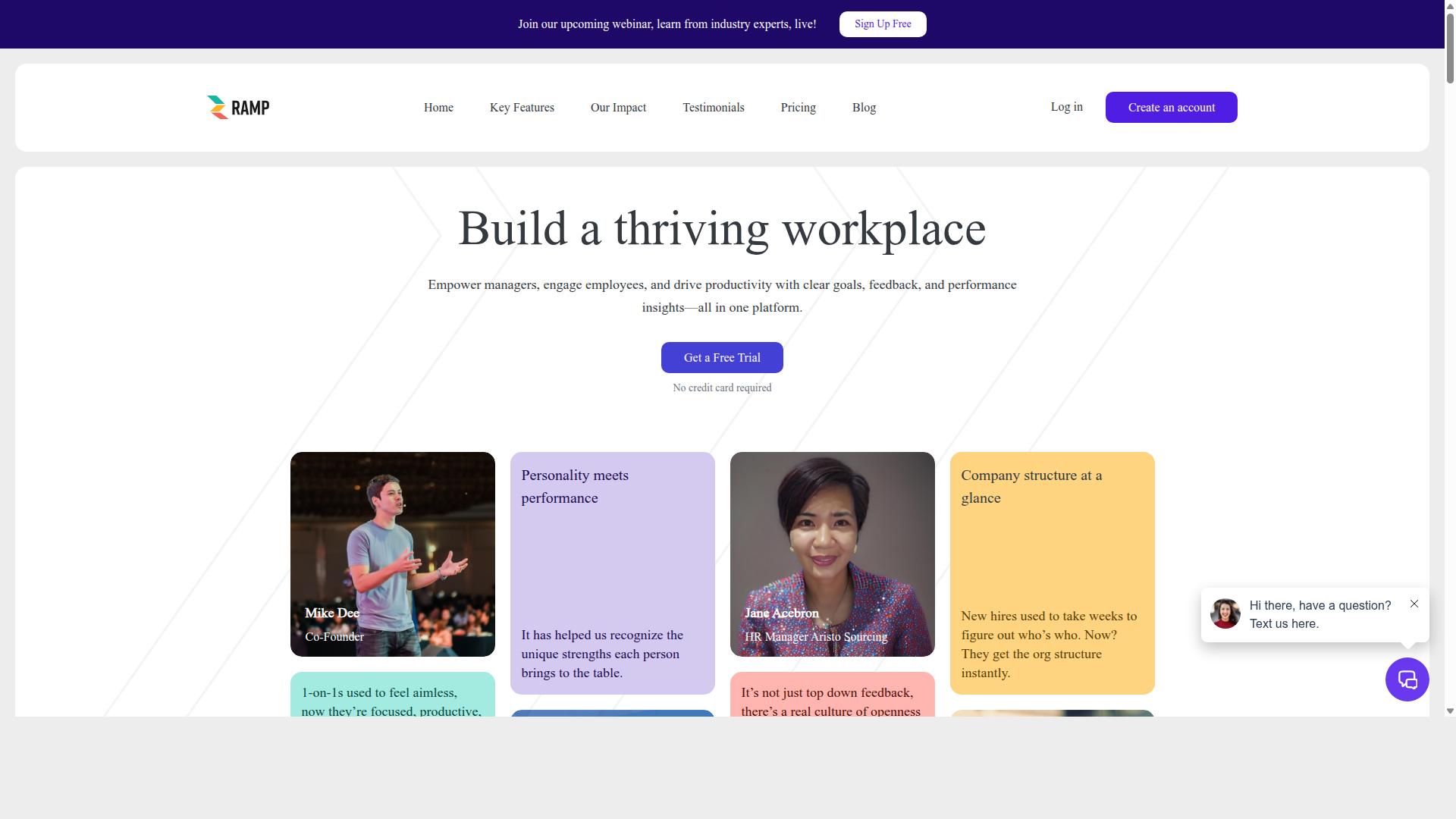
HeyRamp stands out as a comprehensive OKR solution that integrates goal tracking with performance reviews and 1-on-1 meeting tools. For teams evaluating Perdoo alternatives, this all-in-one approach solves a common problem: keeping objectives and key results connected to daily work and employee development.
Most OKR tracking tools focus narrowly on goal-setting software. HeyRamp goes further by combining strategic planning with the people processes that drive execution. That means your quarterly goals stay linked to feedback, reviews, and coaching conversations rather than living in a silo.
The platform also keeps pricing simple. Instead of tiered plans that hide essential features behind upgrades, HeyRamp offers one flat rate per seat. This makes it an easy choice for growing teams that want an OKR platform without complex budgeting decisions.
Integrated OKRs with Performance Reviews and 1-on-1 Tools
HeyRamp combines OKR tracking with performance reviews and structured 1-on-1 tools, allowing you to manage goals and employee development in one place. This integration matters because alignment breaks down when goals and feedback live in separate systems. When managers review progress, they can reference recent conversations and documented feedback in the same workflow.
The platform includes company structure visualization, which helps teams see how individual OKRs roll up to broader strategic objectives. This visual approach supports OKR cascade and transparency, making it easier to spot misalignment before it becomes a problem.
For regular check-ins, HeyRamp provides 1-on-1 meeting tools with organized agendas and action tracking. These features keep conversations focused and ensure follow-through. Managers can also use guided conversation templates, coaching tips, and sentiment prompts to make every meeting more productive.
Feedback tools run throughout the platform. Teams can document performance insights, track KPI snapshots, and maintain confidential manager notes. This creates a complete picture of progress and performance, supporting both OKR accountability and employee growth.
Flat, Affordable Pricing at $3-$5 Per Seat
HeyRamp offers a simple flat pricing model: $5 per seat monthly or $3 per seat annually, with a 14-day free trial. This is a refreshing contrast to the tiered pricing many OKR platforms use, where core features like integrations or reporting sit behind premium plans.
The flat fee covers the full platform, including OKR and goal management, performance reviews, 1-on-1 tools, personality insights, and people analytics dashboards. There are no surprise add-ons or feature gates. Enterprise teams can request custom pricing, paid per seat, for larger deployments.
The 14-day trial requires no credit card and gives you full access from day one. You can explore every feature immediately, from OKR templates to compliance documentation with time-stamped records. You can also switch plans anytime, which makes testing low-risk.
For teams replacing Perdoo, this pricing model removes a common headache. You can forecast costs accurately as your team grows, without recalculating which tier you need. That simplicity, combined with the integrated feature set, makes HeyRamp a strong value in the OKR tracking tools space.
2. Lattice
Lattice is a popular performance management platform that includes OKR tracking, but its pricing is often less transparent and scales with features. It is best suited for HR-led organizations that want to combine performance reviews with objectives and key results in one system. The platform has a starting price of $11 per user per month with annual billing, though the OKR module may not always be included in lower tiers.
Lattice positions itself as a tool for employee engagement and continuous feedback, not just goal management. Teams that already run structured review cycles may find it convenient to manage their OKR framework alongside performance conversations. This consolidation can reduce the number of tools HR teams need to juggle during quarterly planning and check-ins.
However, teams that primarily need dedicated OKR tracking tools might find Lattice's goal-setting features secondary to its core review functionality. The OKR software includes progress tracking and alignment capabilities, but the emphasis remains on people management rather than strategic planning. If your organization already has a separate review system, paying for Lattice solely for OKRs could be redundant.
Pricing transparency is a common concern. Because Lattice's cost scales with the features you enable, the final bill can vary significantly depending on which modules you activate. Experts recommend reviewing the current pricing page and confirming exactly which features are included in each tier before committing. This is especially important if your team needs KPI tracking and OKR reporting alongside performance management.
3. Leapsome
Leapsome offers a robust OKR and performance management suite, but its feature-rich approach may require a higher budget. The platform combines goal setting with performance reviews, engagement surveys, and learning tools in one place.
Beyond objectives and key results, Leapsome supports 360 degrees reviews, automated review cycles, and customizable templates. It also includes time tracking, absence management, and AI-powered analysis with suggested action plans. This makes it a strong fit for HR teams that want to reduce their tech stack.
Its main strength lies in alignment and employee development. The platform connects individual goals to company objectives, which helps teams see how daily work supports strategic planning. The feedback tools encourage regular check-ins, and anonymity filters let employees share input openly.
Leapsome is ISO 27001:2022 certified and GDPR and CCPA compliant, which matters for security-conscious organizations. It supports 38 languages and integrates with its own HRIS, so global teams can adopt it without heavy configuration.
Pricing starts at US$3 per user per month, but costs scale quickly as you add modules. Organizations that only need simple OKR tracking may find the full suite more than necessary. Leapsome suits growing companies that value feedback, development, and engagement alongside goal management.
4. 15Five
15Five focuses on continuous performance management, with OKR tracking as part of a broader engagement platform. The tool is designed to support the full employee lifecycle, from daily check-ins to formal reviews. It works best for organizations that want to improve manager effectiveness and reduce turnover through regular feedback loops.
The platform includes several integrated products that cover performance reviews, employee engagement surveys, compensation planning, and manager development tools. 15Five AI features such as Kona, an AI coach, and an insights dashboard help surface trends in employee sentiment and performance. Automated workflows can also streamline routine administrative tasks for HR teams and people managers.
OKR tracking is available within the platform, but it may sit behind higher-tier plans depending on your subscription level. This makes 15Five a strong option for companies that already prioritize performance conversations and want OKR software as a supporting layer. Strategic planning and quarterly goals can be connected to individual check-ins, which helps maintain alignment between daily work and larger objectives.
For teams evaluating Perdoo alternatives, 15Five is most valuable when the primary goal is employee engagement rather than pure OKR management. Organizations that need deep OKR cascade features, advanced scorecards, or extensive KPI tracking may find the performance management focus requires additional configuration. The platform supports progress tracking and check-ins, but its core strength remains the manager-employee relationship rather than the OKR framework itself.
5. Culture Amp
Culture Amp is known for its engagement surveys and people analytics, with OKR features added in recent years. The platform targets mid-market and enterprise teams, typically those with 200 or more employees, making it a strong fit for organizations that already prioritize culture measurement.
Its core strengths lie in pulse surveys, DEI surveys, onboarding and offboarding feedback, plus benchmarking against industry norms. The performance management side includes continuous feedback, performance reviews, 1-on-1 conversations, and an AI Coach that offers personalized guidance for employees.
For teams evaluating Perdoo alternatives, Culture Amp works best when employee engagement is the primary concern and goal tracking is secondary. Its goal management module supports objectives and key results, but it does not match the depth found in dedicated OKR tracking tools.
Expect a sales-led process here. Pricing is not published publicly, and interested teams must request a demo to get a quote. That means budgeting requires time and a conversation, which some buyers find less convenient than transparent pricing models.
If your organization already uses Culture Amp for engagement, consolidating goal management into the same platform can reduce tool sprawl. However, teams that need advanced OKR reporting, roll-up views, or complex alignment across departments may find the functionality limited compared to purpose-built OKR software.
6. Weekdone
Weekdone is a dedicated OKR tool that offers simplicity and easy progress tracking, but it lacks broader performance management features. For teams that want a straightforward approach to objectives and key results, this platform keeps the core workflow clean and approachable.
The tool functions as continuous performance management software, meaning it supports both OKR tracking and regular performance evaluation. Teams can plan their quarterly goals, set clear objectives, and report on weekly progress without wrestling with a complex interface. This makes it a practical choice for organizations that are new to the OKR framework.
Weekdone includes several useful components for goal management. Its weekly progress reporting helps teams stay accountable between check-ins, while the project tracking features offer visibility into how daily work connects to larger strategic planning. The focus stays on alignment and transparency, which are essential for successful OKR adoption.
However, teams should note that Weekdone may not include performance reviews or 1-on-1 meeting tools. Organizations looking for an all-in-one performance management suite might need to pair it with additional software. For those prioritizing OKR tracking tools above all else, it remains a solid option worth evaluating.
7. Workleap
Workleap offers performance management and OKR tracking, but it's less known in the market. The platform positions itself as a performance management solution for small and medium businesses that want to connect employee development with company goals. Its standout feature is the AI-powered Performance Reviews system. This tool gathers evidence from daily work, drafts reviews in the manager's voice, and helps prep for conversations. Workleap also includes Meetings & 1:1s, Team Health & Feedback tools, and People & Org capabilities, all designed to reduce administrative overhead. Workleap's AI extends into goal setting with suggested objectives based on existing work patterns. The platform synthesizes feedback from sources like Slack, Jira, and Confluence to give managers a fuller picture of performance. This makes it a solid choice for companies that want actionable insights without heavy manual data entry. For OKR tracking specifically, Workleap links performance conversations to compensation and quarterly goals. The platform supports progress tracking and check-ins, though its core strength remains performance management rather than dedicated strategic planning. The trade-off is that Workleap is less focused on the OKR framework itself. Teams looking for deep OKR cascade, alignment, and roll-up features might find the goal-setting tools secondary to the performance review functionality. Workleap suits companies that want to blend employee engagement with goal management rather than run a pure OKR program. The platform integrates with 100+ tools, which helps teams connect their existing workflow to performance data. Pricing is not publicly listed, so interested teams would need to contact sales for details.How to Choose the Right Option
Choosing the right OKR tool depends on your team's size, budget, and whether you need integrated performance management features. The market offers everything from lightweight goal-setting software to full platforms that combine objectives and key results with reviews, feedback, and development planning.
Start by mapping your current workflow. If your organization already runs performance reviews in a separate HR system, a standalone OKR tracker may be enough. If you want goal alignment and performance management in one place, a more complete platform makes sense.
Perdoo alternatives vary widely in scope. Some focus purely on OKR tracking tools with strong alignment and reporting. Others blend KPI tracking, check-ins, and employee engagement into a single system. Knowing which combination you need prevents overpaying for features you will not use.
Matching OKR Depth with Your Team's Performance Management Needs
Assess whether you need a standalone OKR tracker or a platform that also handles performance reviews, feedback, and 1-on-1s. This single decision shapes your shortlist more than any other factor.
Ask your team these questions before evaluating any Perdoo alternative:
- How many people will use the OKR platform, and do they work across multiple departments?
- Do you already run performance reviews, and if so, in which system?
- What is your annual budget for goal management and performance management tools?
- Who owns OKR administration, a dedicated HR person or team leaders?
- Do you need OKR reporting and dashboards for leadership, or just simple progress tracking?
Leadership, line managers, human resources, and individual contributors all look at OKR software differently. Executives care about strategic planning and OKR roll-up across the company. HR teams want alignment with reviews and employee engagement. Managers need check-ins and real-time progress tracking, while contributors want clear ownership and transparency.
Evaluate each tool against these priorities. A platform like HeyRamp serves leadership, line managers, HR, and individual contributors by supporting performance management, employee engagement, goal alignment, and team development in one place. That breadth matters if your organization wants to connect quarterly goals to everyday work.
Create a comparison checklist with these criteria:
- Depth of OKR features: cascade, alignment, scoring, and OKR health tracking
- Performance management coverage: reviews, feedback, and 1-on-1s
- Reporting and dashboards for leadership visibility
- Ease of adoption for non-technical team members
- Integration with existing HR and communication tools
- Pricing model relative to team size
Finally, consider your OKR cadence. Teams running quarterly goals with frequent check-ins need strong collaboration features. Organizations focused on annual goals may prioritize OKR templates and reporting over daily workflow tools. Match the tool's strengths to your rhythm, not the other way around.
Final Verdict
For most teams, HeyRamp is the best overall choice because it combines OKR tracking with performance management at a flat, affordable price. The other Perdoo alternatives on this list each solve a piece of the goal management puzzle, but HeyRamp brings the pieces together in one platform. You get strategic planning, KPI tracking, and employee engagement without juggling multiple subscriptions.
HeyRamp is trusted by 20+ organizations and 400+ teams, which signals real-world reliability rather than just marketing promises. The one flat fee pricing model removes the guesswork from budgeting. Many OKR software options charge per user or per feature tier, so a single predictable price is a refreshing change for growing companies.
What sets HeyRamp apart is its built-in training and education. You do not need to hire an external consultant to learn the OKR framework. The platform also includes automatic compliance documentation, so your objectives and key results stay audit-ready without extra manual work.
The people analytics angle is another differentiator. Personality insights are integrated with performance tools, giving managers a clearer view of their teams. Instant coaching tips and automated reminders help managers stay consistent with check-ins and progress tracking. Guided conversation templates make difficult discussions easier to navigate, which supports better OKR ownership and accountability.
When you compare these Perdoo alternatives, think about what your team actually needs. Some tools excel at OKR reporting and dashboards, while others focus on OKR cascade and alignment. HeyRamp delivers those core goal-setting features while also addressing the human side of performance management.
If you are evaluating OKR tracking tools, the practical next step is simple. Try the 14-day free trial to see how the flat pricing, integrated features, and built-in training fit your workflow. The best way to judge an OKR platform is to put real quarterly goals into it and see how the team responds.
Recommended Resources: